

TEKST
A New Day for the Left? The Victory of Zohran Mamdani
Maybe one of the most important lessons from Mamdani’s campaign is its refusal to settle for a moral victory. From Day One, Zohran and his staff made it clear that they would not settle for raising their profile or claiming a moral victory—their goal was to fight for all New Yorkers and win. The situation is dire enough for leftists almost anywhere in the world. It’s time to organize not to feel good about ourselves, but to win.
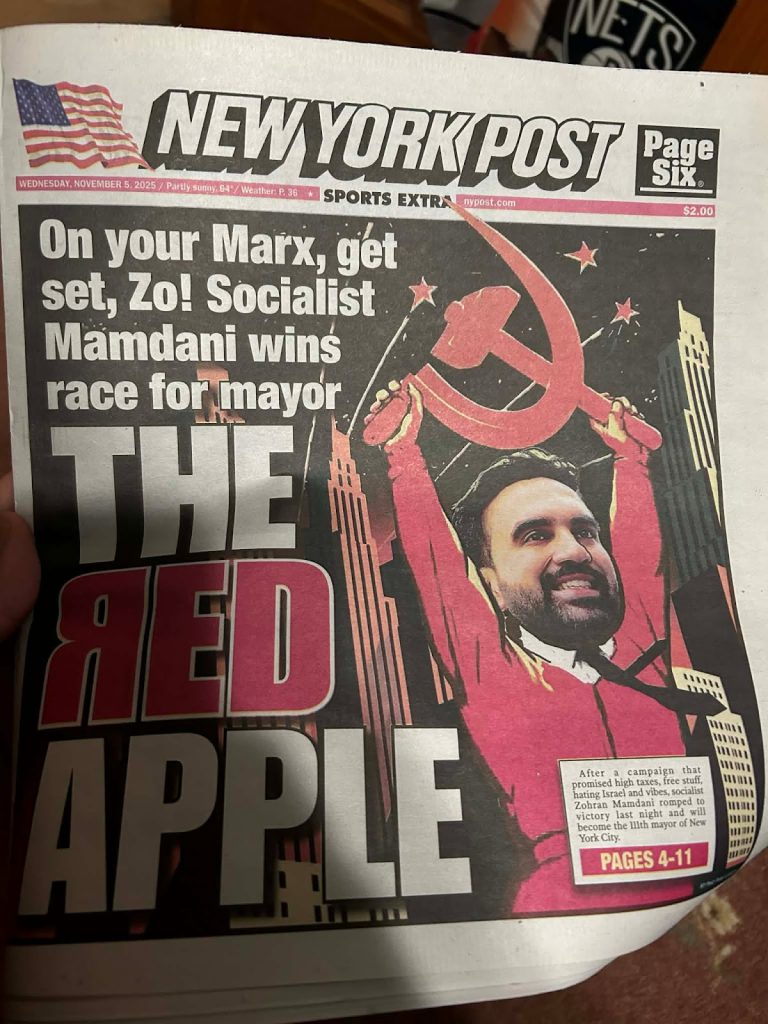
Cover of New York’s biggest right-wing tabloid after Election Day. Photo credit: Mark Duras
Most New York City leftists can recall with perfect clarity the moment when they realized that 34-year-old democratic socialist Zohran Mamdani could actually become mayor of New York City.
For Neeraj Senthil-Kumar, DSA member and Zohran campaign volunteer, that moment was the official campaign kickoff in Brooklyn: “It had a huge turnout and that was when I realized, Oh this campaign might have legs.”
The campaign was up against the prevailing wisdom that a proud socialist, pro-Palestine candidate could never win in a major US election. Zohran was also running as a proud Muslim immigrant in a city which, despite its progressive reputation, has a history of Islamophobic sentiment, including illegal NYPD surveillance of Muslim communities. During the campaign, Zohran’s primary opponent, disgraced former governor Andrew Cuomo, and right-wing media such as the powerful tabloid New York Post targeted him with Islamophobic attacks reminiscent of the 2000s.
In the face of this stern opposition, Zohran won the Democratic primary on June 24th, 2025, then beat Andrew Cuomo again in the general election on November 4th. His victory was the result of years of groundwork by organizers in NYC and beyond. As Zohran is sworn in on January 1st, 2026, his victory offers valuable lessons for the global left, both in terms of strategy and as a caution on the limits of electoralism.
A Victory Built Before Election Day
Zohran’s victory came after years of organizing work by different organizations, including NYC-DSA, the organization which first endorsed him during his 2020 race for State Assembly.
Some of the conditions that made Mamdani’s victory possible in New York are structural. The city’s matching funds program gives public financing to campaigns who receive donations from small grassroots donors, which benefited Zohran. Ranked choice voting in primaries makes it easier for collaborative campaigns like Zohran’s and Brad Lander’s to exist.
Zohran was campaigning among an electorate that was deeply frustrated with the political establishment. Incumbent mayor Eric Adams, a former NYPD officer who was indicted for corruption and struck a suspected deal with the Trump administration to avoid prosecution, was deeply unpopular. “It was a failure of the progressive movement to not run anyone who could beat him last time,” says Neeraj Senthil-Kumar.
Senthil-Kumar also points to the re-election of Donald Trump as president in 2024 as a galvanizing factor in motivating volunteers for Zohran’s campaign. “People felt really powerless after Trump became president and wanted to do something. I certainly felt that way as well.”
Mamdani’s run for mayor came after years of strategic DSA campaigns in New York City local elections. These elections meant that not only were groups of committed democratic socialist legislators in office who could endorse Zohran during his run, but DSA also had thousands of campaign-hardened volunteers at their disposal and bases of likely supporters galvanized by previous campaigns.
Travis Wayne, a Boston DSA organizer who traveled to New York to canvass for Zohran, observed that Mamdani’s campaign also built on the structure of progressive electoral organizing outside of New York City. “He adapted many of the successful tactics of the Bernie 2020 and 2016 campaigns, which introduced innovative practices like hiring staffers for specific targeted outreach to cultural communities and labor tactics for canvassing. Mamdani hired over a dozen such coalition organizers and used Solidarity Tech, a software pioneered for usage by gig worker unionists,” Travis explains.
Creating a Campaign That Will Win
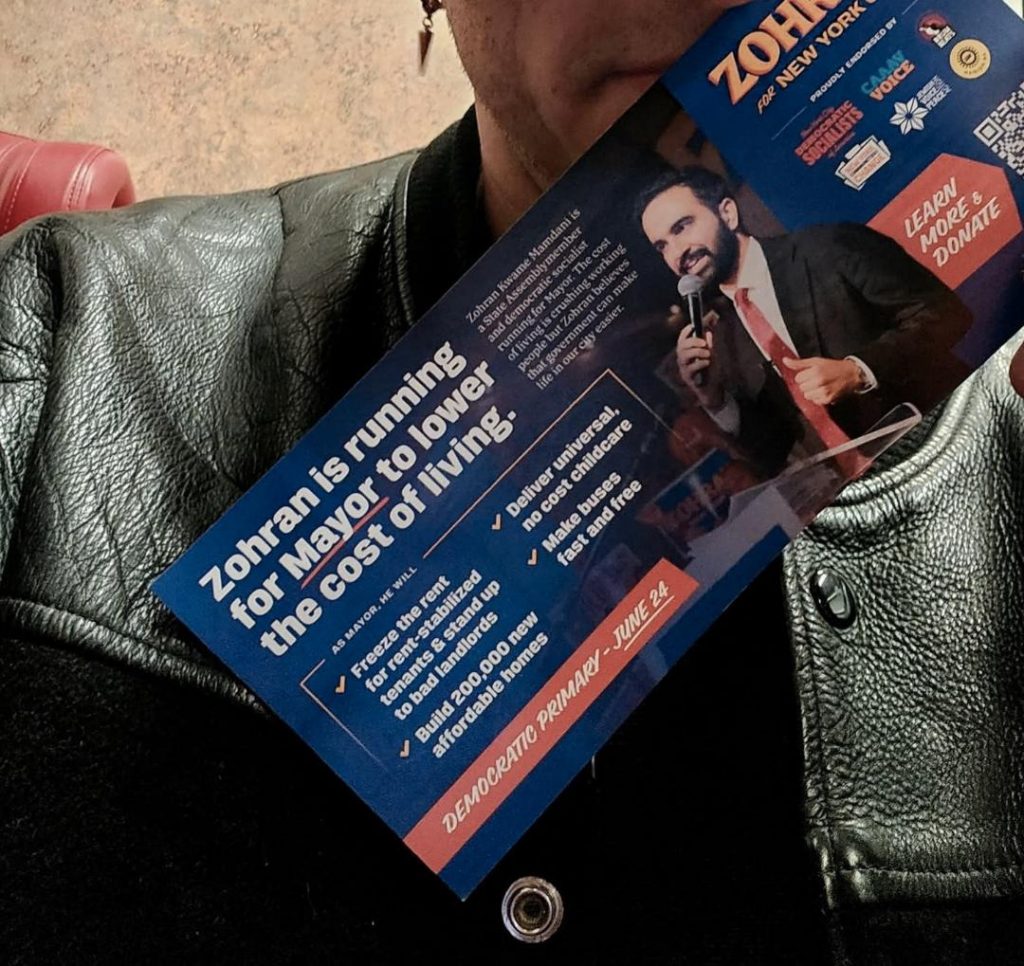
A photo from canvassing, including campaign material. Photo credit: Travis Wayne
Zohran’s path to victory was built on a strong ground game, impeccable strategy, and precision focus on the issues that matter to New Yorkers, including rising fascism.
The campaign mobilized over 50,000 volunteers for the primary alone, including Vlado Vince, originally from Zagreb, who wrote about his experience for Kulturpunkt. “They made it easy for someone with no experience to speak with confidence about issues that matter to voters, and to encourage them to go out and vote,” Vlado says, praising the organizers.
Unlike Vlado, Neeraj was an experienced canvasser already by the time he signed up for his first shift with Zohran. “I’ve been a very active DSA member for close to 8 years now. I think my first big political campaign was Bernie 2020,” he said. Neeraj was promoted to field lead and then staging captain (leadership positions within the canvassing operations), a tactic of the campaign to ensure that newer volunteers benefited from the knowledge of their more experienced peers.
Zohran’s campaign attracted canvassers from other DSA chapters, including Travis, who, like other experienced DSA political operatives, had been following Zohran’s campaign for months. “Me and one other comrade both decided to go canvass in April 2025, which was before his upset primary victory in June, but also before his rise in the polls was taken seriously. We had been following his candidacy since its inception – I even reached out to a Muslim community organizer, someone outside of DSA but from the other anchoring organizing bloc in the campaign, in November 2024 about his viability.”
The structure of the canvassing operation also created a feeling of camaraderie among Zohran’s volunteers and prepared future leaders of NYC politics. “After long hours of doorknocking people would get together, have a social, and talk to each other,” Neeraj remembers. “The votes are very important, but the thing that’s actually long-lasting is the political community.”
The ground campaign was backed up by a savvy political strategy which focused on mobilizing voters that are usually ignored by establishment politicians, especially in primary campaigns, such as young people, immigrants, and lower-income renters.
The campaign mobilized those voters by focusing on issues that matter to everyday New Yorkers. Mamdani’s core promises of Freeze the Rent, Free (and Fast) Buses, and Free Childcare spoke to ordinary New Yorkers who were feeling the squeeze from rising costs in the city. Although it is the shiny production of Mamdani’s communications that got the most media attention, the message-driven focus of the campaign which met voters where they were at was the real key to victory.
Mamdani also directly addressed the rising fascism in the United States during his time on the campaign trail. He repeatedly named the United States’ role in the ongoing genocide in Gaza, even though that increased the racism and allegations of anti-Semitism he faced as the only Muslim mayoral candidate.
Mamdani also stood up against the fascist creep of Trump’s administration, including directly confronting “border czar” Tom Homan over the illegal kidnapping and detention of Palestinian student Mahmoud Khalil. That fight endeared Mamdani to an electorate who was tired of Democrats who were unwilling to stand up to fascism. Vlado remembers one particularly memorable interaction with an older woman in his neighborhood of Flatbush. “She must have been in her 80s, yelling that she can’t take this anymore—what that clown in Washington is doing—and that she’s absolutely coming out to vote for Zohran because things have to change. That was so powerful.”
Mamdani’s antifascism was also on display in his campaign’s positive portrayal of New York City. A key tenet of fascism is anti-urbanism, amplified in the United States by the hatred of immigrants and minorities who live in cities. Andrew Cuomo alluded to this fascist demonization of New York City during his campaign, which attempted to evoke the fear of an unruly, lawless city in voters. By contrast, Mamdani’s campaign communications focused on the joys of New York, from Coney Island polar plunges to multilingual campaign videos. Portraying the city as a joyful place to live made stronger by its diversity rather than capitulating to fascist stereotypes endeared him to voters and shifted the narrative around the city.
Now What?
Mamdani won so decisively in the general election that the victory was announced around 40 minutes after polls closed. Victory parties were packed. The city’s main rightwing tabloid, the New York Post, published an unhinged cover, as anticipated, which sold out as leftists rushed to buy it (I made my brother go get me a copy). Although most of Zohran’s volunteers are aware that the mayor will have to make compromises once he takes office, they are optimistic about his chances, especially compared to other Democratic politicians. “Democrats […] demonstrate over and over again that they’re not actually going in with an argument, they’re going in ready to compromise, but I think with Zohran he has more leverage to bargain from a position of strength,” Neeraj says.
But the reality of what it means to be a democratic socialist mayor in the world’s biggest city has already set in. As mayor, Mamdani will have to deal with the powerful and hostile City Council. In an unprecedentedly fast election, councilmember Julie Menin was elected as Council speaker after promising her opposition to Mamdani’s agenda.
Like any progressive mayor of New York City, one of Mamdani’s biggest challenges will come from managing the NYPD, which functions as a semi-autonomous private army with a multi-billion dollar budget. Mamdani has already walked back comments he made about police abolition in 2020 and pledged to retain Jessica Tisch, the current police commissioner, a billionaire heiress who has opposed police reform efforts and is unpopular with the rank-and-file of departments she has managed.
Travis notes that these disappointments are to be expected. “These are the results of the current balance of class forces in New York City, and can be understood as such. And just as they show us something about that balance, so does Zohran’s victory — what new opportunities for organization and power exist in the conjuncture as a result of this shift?”
There are also the limits of municipal power. Despite initial visits to Trump going well, Mamdani will still have to deal with federal government control of financing to New York City, and the incursions of national militarized law enforcement agencies such as ICE and the National Guard. The governor of New York state also controls significant levers related to New York City policies. Neeraj is optimistic about Zohran’s ability to get the governor of New York, Kathy Hochul, to sign on to his program. “The pressure campaign has been very successful on her and you’re already seeing movement on these things,” he says.
Even though they are aware of the limits on what Zohran can achieve, his victory is a galvanizing force for leftists across the United States. “The unique position of the mayoralty of New York makes this highly visible,” shares Travis. “Already, in Las Vegas [his hometown], membership has reached a historic high with five hundred strong cadre members after a bump in membership from Mamdani.” Travis sees a political future for DSA dependent on Zohran’s actions. “If he can position himself to be the primary opposition figure to Trump, then DSA has the chance far greater than previously to supplant the bourgeois party and become the primary opposition to fascism in the popular imagination.”
Maybe one of the most important lessons from Mamdani’s campaign is its refusal to settle for a moral victory. From Day One, Zohran and his staff made it clear that they would not settle for raising their profile or claiming a moral victory—their goal was to fight for all New Yorkers and win. The situation is dire enough for leftists almost anywhere in the world. It’s time to organize not to feel good about ourselves, but to win.
Rebecca Duras
Tekst je financiran sredstvima Fonda za poticanje pluralizma i raznovrsnosti elektroničkih medija Agencije za elektroničke medije za 2025. godinu.


- PROGRAM: TRNJANSKI KRESOVI 2025.07/05/2025
- Pretprogram TK2025: Diskusija “Fašizam, fašizacija, antifašizam”05/05/2025
- Izložba “ZAGREB: OSLOBOĐENJE”05/05/2025
- Pretprogram TK2025: Tribina “Umjetnički rad – sindikaliziranje umjetnosti”05/05/2025
- Osamdeset godina od oslobođenja: Proglas Trnjanskih Kresova 2025.05/05/2025
- Trnjanski kresovi 2025. – 80 godina od oslobođenja Zagreba!28/03/2025
- Proglas Trnjanskih kresova 2024.02/05/2024

Mreža antifašistkinja Zagreba korisnica je institucionalne podrške Nacionalne zaklade za razvoj civilnoga društva za stabilizaciju i razvoj udruge.